Physical access to a Linux machine often guarantees total system compromise if boot configurations remain unhardened. By default, anyone with physical or KVM console access can interrupt the GRUB bootloader, append single, init=/bin/sh, or emergency to the kernel arguments, and bypass authentication into a root shell.
Securing the boot process requires hardening three independent layers:
- Password-protecting the GRUB bootloader
- Requiring authentication for single-user/emergency mode
- Disabling interactive startup prompts and console reboot hotkeys
1. Password-Protecting Single-User Mode (sulogin)
In legacy SysVinit/Upstart configurations (/etc/sysconfig/init):
# Default may allow unauthenticated root access via sushell:
# SINGLE=/sbin/sushell

# Change to sulogin to mandate root password verification:
SINGLE=/sbin/sulogin
On modern systemd distributions (RHEL 7/8/9, Ubuntu 18.04+), emergency and rescue targets invoke /usr/lib/systemd/systemd-sulogin-shell by default. Verify that root authentication is enforced before spawning maintenance shells:
# Check emergency service definition
systemctl cat emergency.service | grep ExecStart
# ExecStart=-/usr/lib/systemd/systemd-sulogin-shell emergency
When someone triggers maintenance mode, the console demands root credentials before granting shell access:
Give root password for maintenance
(or type Control-D to continue):
2. Password-Protecting the GRUB2 Bootloader
Protecting the bootloader prevents unauthorized users from modifying kernel parameters or choosing alternate kernels without authentication:
-
Generate an encrypted PBKDF2 password hash:
grub2-setpassword
# (Or: grub-mkpasswd-pbkdf2)
This stores the cryptographic hash in
/boot/grub2/user.cfg. -
Define an authorized superuser in
/etc/grub.d/01_users:cat <<EOF >> /etc/grub.d/01_users set superusers="admin" password_pbkdf2 admin grub.pbkdf2.sha512... EOF -
Rebuild the GRUB configuration:
# BIOS:
sudo grub2-mkconfig -o /boot/grub2/grub.cfg
# UEFI:
sudo grub2-mkconfig -o /boot/efi/EFI/redhat/grub.cfg
Users can still boot standard kernels normally, but pressing e to edit parameters requires the admin password.
3. Disabling Interactive Startup (PROMPT=no)
During legacy startup sequences, pressing i initiates interactive startup, allowing anyone at the console to selectively bypass system services (including the firewall / iptables):
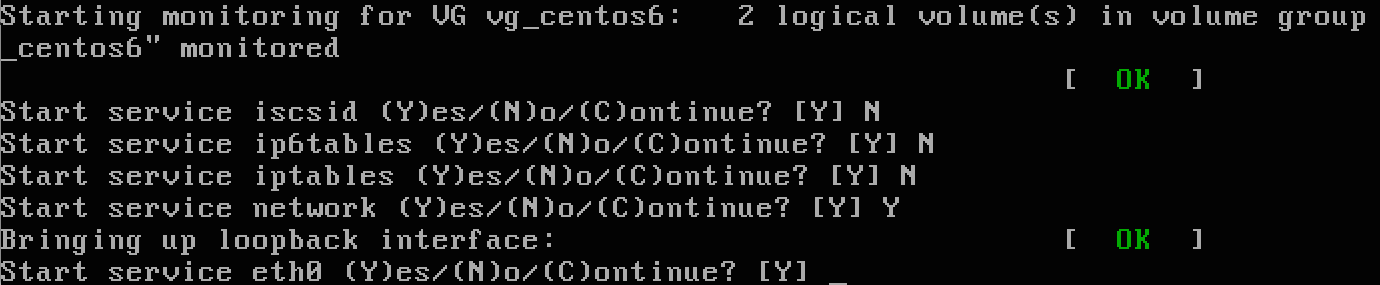
Disable this prompt in /etc/sysconfig/init:
PROMPT=no
4. Disabling Console Ctrl+Alt+Delete Reboots
Prevent malicious or accidental console keystrokes from rebooting the server:
On systemd:
Mask the target responsible for handling the interrupt:
sudo systemctl mask ctrl-alt-del.target
On Upstart:
Override /etc/init/control-alt-delete.override:
echo "exec /usr/bin/logger -p authpriv.warning 'Ctrl-Alt-Delete pressed at console; reboot blocked.'" | sudo tee /etc/init/control-alt-delete.override